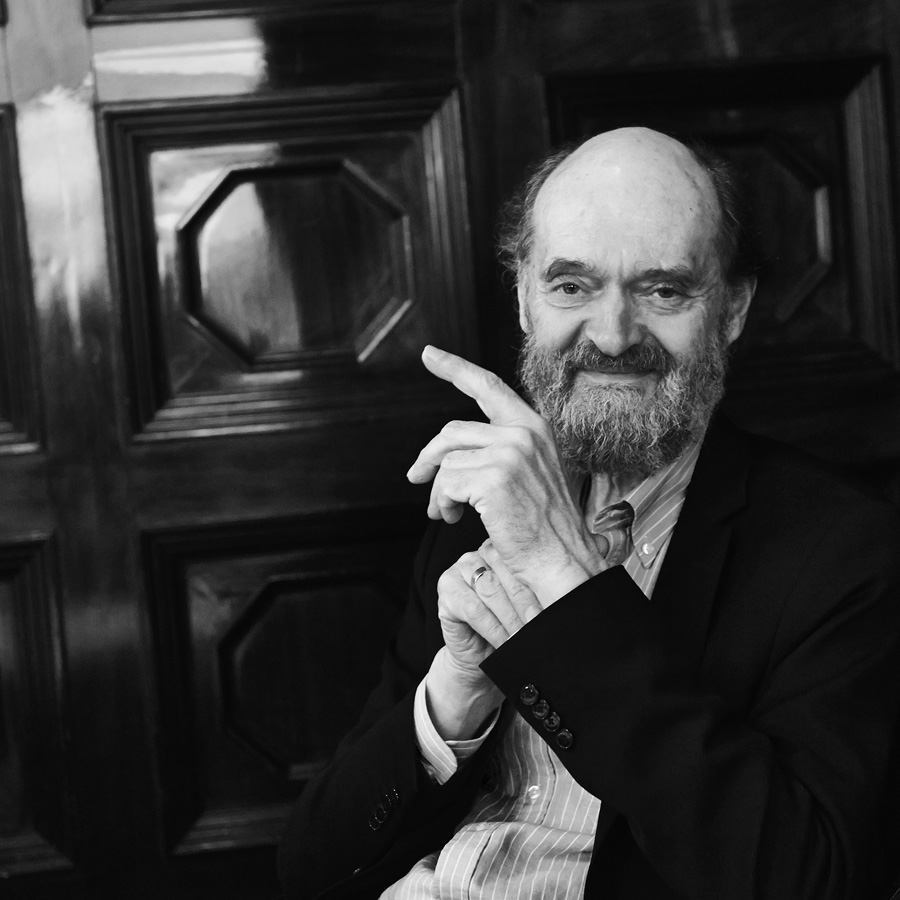
ARVO PÄRT
Composer“Love is the source of all arts. Art will exist for as long as there exists an ability to love.”
(Arvo Pärt)
Born on September 11, 1935, in Paide, Estonia. In 1954, he began studying music at the music school in Tallinn, but had to complete his military service from 1954 to 1956. From 1957 to 1963, Pärt studied composition with Heino Eller at the Tallinn Conservatory and also worked as a sound engineer for Estonian Radio from 1958 to 1967.
His first creative period began with neoclassical piano music, followed by dodecaphony (twelve-tone technique), soundscape composition, aleatoric music (chance music), and collage technique. With “Nekrolog” (1960), the first Baltic twelve-tone work, and “Perpetuum mobile” (1963), Pärt became a radical representative of the Soviet avant-garde. These works also brought him his first recognition in the West. Pärt then withdrew from public life for almost eight years. Pärt's open profession of Christianity (the sung “Credo in Jesum Christum”) was considered a political provocation and an attack on the regime. To earn a living for his family, he wrote film scores.
Years of reflection and intensive study of Gregorian chant, the Notre Dame School, and classical vocal polyphony led Pärt to drastically reduce his compositional means to a few rhythmic, melodic, and harmonic building blocks. This new compositional style, based on a bell-like triad called “Tintinnabuli” (Latin for “little bell”), has permeated his works from the piano piece “Für Alina” (1976) to the present day.
In 1980, under pressure from the Soviet government, Arvo Pärt emigrated with his family to Vienna, where he was granted Austrian citizenship. In 1981, he came to Berlin-Lankwitz with his family on a scholarship from the German Academic Exchange Service. Pärt achieved international recognition and popularity in 1984 with his first record/CD release, which included his best-known compositions to date: “Tabula Rasa” (1977), ‘Fratres’ (1977), and “Cantus in Memory of Benjamin Britten” (1977).
Following the collapse of the Soviet Union and Estonia's independence, Pärt has been living in Estonia again since 2010. In the same year, he and his family founded the Arvo Pärt Centre in Laulasmaa near Tallinn. He has received numerous international awards and honors for his work, including honorary membership of the American Academy of Arts and Letters in 1996, appointment as a member of the Pontifical Council for Culture at the Vatican in 2011, and honorary doctorates from the University of Sydney in 1996, the University of Durham in 2002, the University of St. Andrews in 2010, and the University of Oxford in 2016.
"I have discovered that it is enough for a single note to be played beautifully. That note, the silence or the quiet, calms me. I work with little material, with one voice, with two voices. I build from primitive material, from a triad, a certain tone quality. The three sounds of a triad have a bell-like effect. That's why I called it tintinnabuli." (Arvo Pärt)
Awards (Selection)
2018 Gloria-Artis-Medal
2017 Joseph-Ratzinger-Prize
2015 Austrian Decoration of Honour for Science and Art
2014 Praemium Imperiale
2011 Chevalier de la Légion d‘Honneur
2008 Cross of Honour for Science and Art, First Class
2008 Léonie-Sonning-Music Award
2007 International Bridge Prize (of the European City of Görlitz/Zgorzelec)
2005 European Church Music Prize
2005 Musical America Composer of the Year
2001 Commandeur de l‘Ordre des Arts et des Lettres
2000 Herder-Prize
1989 Edison Classical Music Award
Works (Selection)
2018 Symphony No. 4, Los Angeles for string orchestra, harp, timpani and percussion
2015 Adam’s Passion, Robert Wilson (production), based on Adam's Lament, Tabula Rasa, Miserere and Sequentia
2009 Adam‘s Lament for choir and string orchestra
1985-2008 Stabat Mater for choir and string orchestra (Premiere Vienna Festival/Wiener Festwochen)
2002 Lamentate for piano and orchestra (Premiere, Tate Modern London)
1999-2000 Orient & Occident for string orchestra (commissioned by Berliner Festwochen)
1997 Kanon Pokajanen for choir a capella
1994-1996 Litany: Prayers of St. John Chrysostom for each hour of the day and night für soloists, choir and orchestra (Premiere, Oregon Bach Festival in Eugen, USA)
1989-1992 Miserere for soloists, choir, ensemble and organ
1988-1990 Festina lente for string orchestra, harp ad lib.
1982 Passio Domini nostri Jesu Christi secundum Joannem for soloists, vocal ensemble, choir and instrumental ensemble
1978-2003 „Spiegel im Spiegel“ for violin or viola or cello and piano
1977-1991 Fratres for violine and piano, string quartet, string orchestra, percussion
1976-1980 „15 Tintinnabuli-compositions“ (Pari Intervallo (1976), Cantus in Memory of Benjamin Britten (1977), Fratres (1977), Tabula rasa (1977) and Spiegel im Spiegel (1978))
1976 „Für Alina“ for piano
1971 Symphony No. 3
1968 Credo for piano, choir and orchestra
1966 Symphony No. 2
1964 Quintettino for flute, oboe, clarinet, bassoon and horn
1963 Symphony No. 1
1963 Perpetuum mobile for orchestra
1960 „Nekrolog“ for orchestra
Bibliography (Selection)
2006 Conen, Hermann (publisher): Arvo Pärt – Die Musik des Tintinnabuli-Stils. Cologne: Dohr
2006 Gröhn, Constantin: Dieter Schnebel und Arvo Pärt – Komponisten als „Theologen“. Berlin, Münster: Lit
2002 Kautny, Oliver: Arvo Pärt zwischen Ost und West – Rezeptionsgeschichte. Stuttgart, Weimar: Metzler
1997 Hillier, Paul: Arvo Pärt. Oxford: Oxford University Press