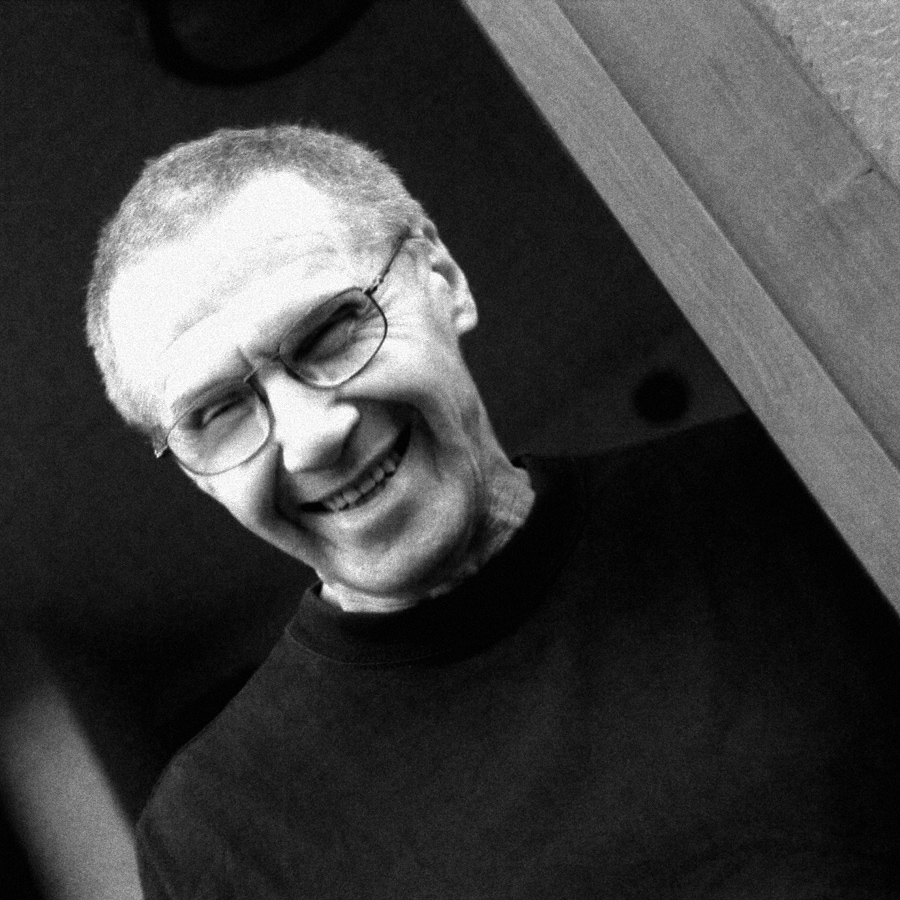
GYÖRGY KURTAG
ComposerBorn on February 19, 1926, in Lugoj, Transylvania, Romania. From 1940, he received piano lessons from Magda Kardos and studied composition with Max Eisikovits in Timisoara. In 1946, he moved to Budapest and studied at the Franz Liszt Academy. His teachers included Sándor Veress and Ferenc Farkas (composition), Pál Kadosa (piano), and Leó Weiner (chamber music). At the music academy, he met György Ligeti during the entrance exam, with whom he formed a lifelong friendship. Unlike Ligeti, he remained in Hungary in 1956 and obtained a passport during the Hungarian uprising. Kurtag stayed in Paris from 1957 to 1958, where he studied with Darius Milhaud (composition) and Olivier Messiaen (analysis). On his return journey to Budapest, he met Ligeti and Stockhausen in Cologne, whose works Artikulation (Ligety) and Gruppen (Stockhausen) were to influence his further development. Back in Budapest, he composed his Opus 1, a string quartet, as a sign of the actual beginning of his creative work.
From 1958 to 1963, Kurtág worked as a professor at the Béla Bartók Music School in Budapest. From 1960 to 1968, he was soloist coach for the Budapest National Philharmonic Orchestra. In 1967, he became assistant to Pál Kadosa at the Ferenc Liszt Academy of Music, and the following year he was appointed professor of chamber music. He held this position until his retirement in 1986. Until 1993, he continued to teach individual students at the academy.
After the fall of the Iron Curtain, Kurtág worked increasingly outside Hungary, as composer in residence with the Berlin Philharmonic (1993 to 1994), at the Vienna Konzerthaus (1995), in the Netherlands (1996 to 1998), again in Berlin (1998 to 1999), and in Paris at the invitation of the Ensemble Intercontemporain, the Cité de la Musique, and the Festival d'Automne.
Alongside Ligeti, Kurtág is considered the most important contemporary Hungarian composer. His music is characterized by a similar condensation of musical textures as that of Anton Webern. Unlike Webern, however, Kurtág's music is more playful and at the same time more concentrated.
Awards (Selection)
2015 Frontiers of Knowledge Award
2013 Royal Philharmonic Society Gold Medal
2012 Wihuri-Sibelius-Prize
2009 Golden Lion, Venice Biennale
2006 Grand Cross of the Order of Merit of the Republic of Hungary
2006 Grawemeyer Award
2003 Léonie-Sonning-Music Award
2001 Friedrich-Hölderlin-Prize
2001 Commander’s Cross with Star of the Hungarian Order of Merit of the Republic of Hungary
2001 Honorary citizen of Budapest
2000 John-Cage-Prize
1998 Ernst von Siemens Music Prize
1998 Austrian Decoration of Honour for Science and Art
1994 Austrian State Prize for European Composers
1993 Prix de Composition Musicale der Foundation Prince Pierre de Monaco
1993 Antonio-Feltrinelli-Prize
1985 Officier de l‘Ordre des Arts et des Lettres
Works (Selection)
2018 Fin de partie. Opera (Premiere at the Teatro alla Scala, Milan)
1994 “Stele”, op. 33 for orchestra
1993-1997 “Hölderlin-Gesänge”, op. 35, for baritone, trombone and tuba
1973-1975 Four songs on the poems by János Pilinszky for baritone and chamber ensemble
1970-1971/1997 4 Capriccios for soprano and chamber orchestra
1989-1990 “Doppelkonzert”, op. 27/2, for piano, violoncello and two chamber ensembles
1987-1988 “…quasi una fantasia…”, op. 27/1, for piano and orchestra
1985-1987 “Kafka-Fragmente”, op. 24 for soprano and violine
1979 Omaggio a luigi nono for choir
1976-1980 “Messages de feu Demoiselle R. V. Troussova (Botschaften der verblichenen R.V. Trussova)”, op. 17 for soprano and ensemble
1969 “In Memory of a Winter Evening” for soprano, violin and cimbalom
1963-1968 “The Sayings of Péter Bornemisza” for soprano and piano
1960 “8 piano pieces” for violin and cimbalom
1959 Streichquartett, op. 1 (String quartet)
Bibliography (Selection)
1986 Spangemacher, Friedrich (publisher): György Kurtág (Musik der Zeit, Band 5). Berlin: Boosey & Hawkes