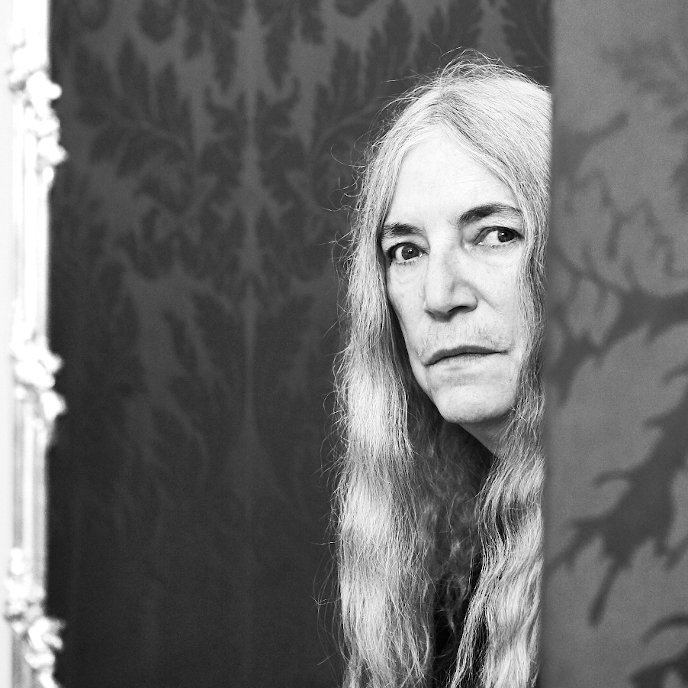
PATTI SMITH
Singer/Songwriter/Photographer/AuthorBorn on December 30, 1946, as Patricia Lee (“Patti”) Smith in Chicago. She left school without a diploma and enrolled in a teacher training college (to become an art teacher), which she had to leave prematurely. Smith had various jobs during and after her training, including working in a toy factory. She later processed the bad experiences of this time into the poem “Piss Factory,” which was used for the B-side of her first single in 1974. Smith's writing was influenced by Jean-Arthur Rimbaud and Charles Baudelaire. She also drew inspiration from William Blake, Lewis Carroll, and William Butler Yeats, among others. In 1966, Smith began drawing and painting, and she also became interested in sculpture, particularly that of Constantin Brancusi. Her frustrating experiences in the provinces and her interest in the visual arts led her to New York in 1967, where she began studying art.
In 1968, Smith met Robert Mapplethorpe, who was the same age, in New York. For a while, Smith and Mapplethorpe lived in New York's Chelsea Hotel, a cult location for progressive rock and pop culture. In 1970/71, Smith devoted herself more to writing. She also worked as a music critic for the magazines Rock, Rolling Stone, Crawdaddy, and Creem. During this time, Smith's first poetry collection, Seventh Heaven, was published, followed by Witt (1973) and Babel (1978), among others. Smith took a decisive step on her way to becoming a rock star when she began reciting her poems in public. In 1971, she was accompanied on guitar for the first time by Lenny Kaye. In the spring of 1974, pianist and keyboardist Richard Arthur Sohl joined the band. At the end of 1974, the trio was reinforced by Prague bassist Ivan Kral, and in the spring of 1975, drummer Jay Dee Daugherty joined, completing the Patti Smith Group. One of the first to see the newly formed Patti Smith Group was Bob Dylan. At the end of 1975, the first LP, Horses, was released on the newly founded Arista label. Critics raved about the album, and Horses later became regarded as one of the best debut albums in the history of rock music.
“Because The Night,” which was taken from the album, was the result of a collaboration with Bruce Springsteen and was to become her greatest commercial success. In addition to “Babel” and “Easter,” there was a third Smith event in 1978: a second major exhibition in New York featuring Patti Smith's drawings, which also included photographic works by Robert Mapplethorpe. In 1980, Patti Smith married guitarist Fred “Sonic” Smith. The Patti Smith Group's fourth album, “Wave,” was released in 1979. That same year saw what was to be Smith's last tour for the time being, with a final concert in Florence. Smith then withdrew from public life for artistic and family reasons. During this time, she worked on her fifth album, “Dream Of Life,” which was released in 1988.
Robert Mapplethorpe was the first of Smith's companions to die. In 1994, her husband Fred Smith died, followed a few weeks later by her brother Todd. Patti Smith had been working with Fred Smith on a new album—at least one track was already finished (Gone Again). In 1996, it became the first and title track of Smith's sixth regular LP. In December 1995, Patti Smith briefly joined Bob Dylan's Never-Ending Tour. Further US concerts by the reduced Patti Smith Group followed in March 1996, and in the summer of 1996, parallel to the release of Gone Again, the first European tour in 17 years took place. In 1997, Smith had to cope with the deaths of her idols Allen Ginsberg and William S. Burroughs. The still fresh wounds from the deaths of so many loved ones in recent years meant that the album “Peace And Noise,” released in 1997, also had a sombre tone.
While only one album was released during her long creative hiatus from the early 1980s, Smith returned to music in 1996 alongside her involvement in the international art scene. Her album “Gung Ho” was released in 2000. In 2002, she and her label Arista parted ways after 27 years. Arista released the compilation album “Land (1975-2002)” to mark the end of their relationship. Her next album, “Trampin',” was released by Columbia Records in 2004. In 2007, she recorded the album “Twelve,” which consists of twelve cover versions of songs from the last 40 years. In 2010, she published an autobiographical book, Just Kids, which deals with her time in the 1970s, especially with Robert Mapplethorpe. In 2010, she was honored with an honorary doctorate from the Pratt Institute. Smith returned to the public eye in mid-2012 with a new album, Banga, which she dedicated to those who had passed away. This was followed by another book, M Train, which is considered a sequel to Just Kids.
The icon received enormous international attention when she performed Bob Dylan's song “A Hard Rain's A-Gonna Fall” in Stockholm in December 2016 on behalf of the absent Dylan, who had been awarded the Nobel Prize for Literature.
Awards (Selection)
2019 Austrian Decoration of Honour for Science and Art
2013 Hepburn Medal
2011 Polar Music Prize
2010 National Book Award
2007 Aufnahme in die Rock’n Roll Hall of Fame
2005 Commandeur de l'Ordre des Arts et des Lettres
1997, 2000, 2015, 2016 Grammy nominations
Works (Selection)
2019 Year of the Monkey
2016 M Train
2015 Collected Lyrics, 1970-2015
2010 Just Kids
2011 Woolgathering
2005 Auguries of Innocence
1999 Complete: Lyrics, Reflections and Notes for the Future
1996 Coral Sea
1994 Early Work, 1970-1979
1978 Babel
1973 Witt
1972 Seventh Heaven
Discography (Selection)
2012 Banga
2007 Twelve
2004 Trampin
2002 Land (1975-2002)
2000 Gung Ho
1997 Peace and Noise
1996 Gone Again
1988 Dream of Life
1979 Wave
1978 Easter
1976 Radio Ethiopia
1975 Horses
Filmography (Selection)
2010 Godard, Jean-Luc (director): Film socialisme. Film
2008 Sebring, Steven (director): Patti Smith – Dream Of Life. Documentary film
Bibliography (Selection)
2018 Kuckuk, Henning E.: Patti Smiths kosmopolitische Stimme. Performances – Netzwerke – Autobiografie. Bielefeld: transcript Verlag
2008 Bockris, Victor: Patti Smith. Frankfurt: Krüger
2007 Stefanko, Franko: Patti Smith American Artist. Fotografien von Frank Stefanko, Vorwort von Patti Smith. Berlin: Schwarzkopf & Schwarzkopf Verlag